How Independent Electronic Artists Make Money
How independent electronic artists make money: royalties already owed, teaching, live shows and an email list. What pays, what barely does, and why.
Independent electronic artists make money from four places, and for many of them streaming is the smallest. The others are royalties you are owed but have not claimed, teaching what you know, live shows, and a list of people who asked to hear from you.
I run The Great Medicine Show, an Austin bass and electronic project, as a business and not only as a catalogue. What follows is general reasoning about how these lines tend to work for artists in this position. I am not giving any income, royalty or fee figures, because the shape of the thing is more useful than my particular numbers. Streaming pays little for the hours most new artists put into it. Teaching pays you directly for what you already know. Live shows come with a fee agreed ahead of time, which makes them easier to plan around.
Why does streaming pay so little?
I have released more than 100 songs, and Spotify's 2025 figures for the project show 1.20 million streams from about 226,000 listeners in 166 countries. Those numbers matter for reach. They say much less about income.
A single stream pays a fraction of a cent. That fraction then passes through a distributor, a label or aggregator if you have one, and a collaborator split if the track is a joint record. Making more songs does not change that arithmetic by much.
Streaming still has a real job: it is how a stranger decides whether you are worth a ticket or a lesson. Treat it as a shop window, and if you count on it as a paycheck, you will be disappointed.
What are royalties you are already owed?
Sort these out first, because they pay on plays that already happened.
When your music is played, several different organisations collect money for different kinds of use, and none of them will find you unless you register. In the United States the main ones are:
- A performing rights organisation, such as BMI or ASCAP, which collects when your songs as compositions are performed publicly.
- The MLC, which collects the mechanical royalties that streaming services owe songwriters and publishers in the US.
- SoundExchange, which collects digital performance royalties for the recording itself when it plays on internet radio, satellite radio and similar services.
SoundExchange has a trap in it. You can register as a recording artist, as a rights owner, or as both. If you made and own your own masters, you want both, because registering only as the artist leaves the owner share unclaimed.
None of this makes anyone rich. The work is paperwork and the money arrives slowly and in small amounts. But it costs nothing to join, it does not depend on a viral moment, and it keeps paying on a catalogue that already exists.
Does teaching really pay more than music?
Often, hour for hour, yes. The student pays you directly for something you already know, with no platform in between and nothing to buy first.
By my own account I started producing in 2004, and I have taught as well as played. I was on the teaching faculty at the High Vibe Music Retreat in 2023, four days of production and DJ masterclasses at Mandala Springs in California. I also hosted The Alchemy of Bass, an all inclusive production retreat with Govinda, Axel Thesleff and AKRIZA.
If a full retreat is too much to start with, a single session is a fair place to begin. Genre Specific Sound Design is a two hour session on building sounds that fit a genre, and the rest of what I teach is on the courses page.
The limit is that teaching trades hours for money, so it does not grow while you sleep. And people do not pay to hear that you love bass music. They pay to learn how you build a drop, and why the second one hits harder than the first.
Why do live shows pay more reliably?
A show is usually a fee agreed before anyone arrives. Whether the room is full of people who already know your tracks matters less to the booking than whether you can hold the night. A stream count only tells you what happened after the fact, which is a different kind of certainty.
The Great Medicine Show has been listed at festivals and venues including Unison Festival and PlayThink in Kentucky. I have been associated with Indra's Awarehouse in Austin since 2018, by my own account. A festival listing proves you were advertised, not that you headlined, and I try never to blur that. In 2022 I was top billed at Indra's New Year's Eve, Ascent, an evening of aerial, acrobatics and ceremony. In 2024 I shared a bill with Axel Thesleff, Govinda and AKRIZA at the Alchemical Bass Symphony.
Music for the People in Belton, Texas, was a bigger kind of show. By my own account, it was a sold out production with a cast of more than fourteen and months of rehearsal. I have no ticket report to hand you, so take it as my account.
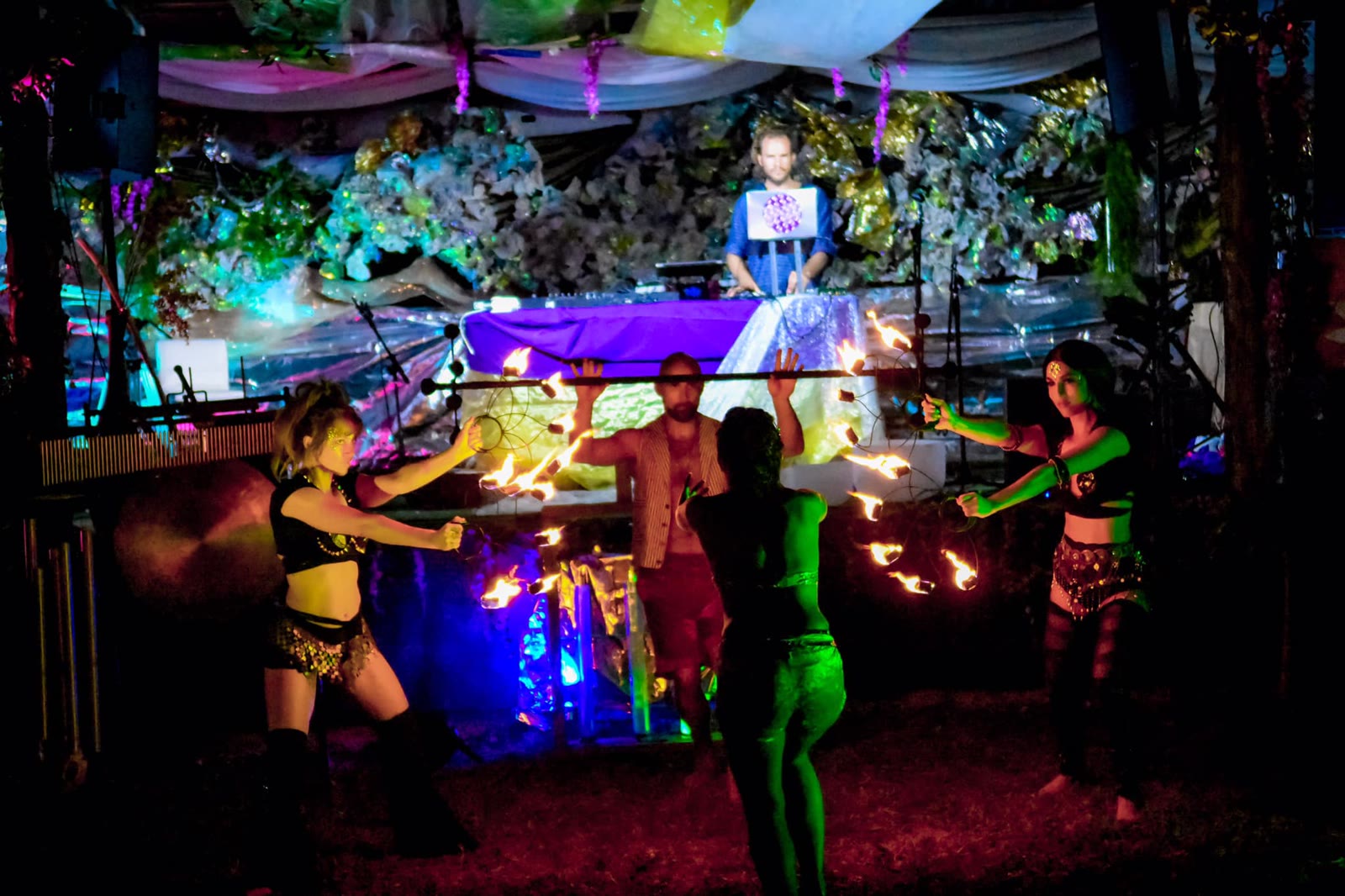
The live show can run from a solo DJ set to a full production with dancers, fire performers and aerial, and the two are not the same product. A solo set is simpler to fit into a night. A full production takes longer to put together, but it offers a promoter a whole evening rather than a set. Being able to offer both sizes means more ways to be booked.
Ecstatic dance is another room entirely. I have played it for over ten years, by my own account, and it asks for a different arc from a festival peak hour, because the floor is following a journey and not waiting for a drop. Promoters and bookers can find the details in the press kit.
What is an email list for?
Streaming platforms hold the relationship with your listeners. You can have a catalogue and a large audience on a service and still have no direct way to reach any of them. When you want to tell people about a show, a class or a release, you depend on an algorithm deciding whether to show them your post.
A person on your email list is different. They typed their address in and asked to hear from you, so you can write to them without asking a platform for permission. It is the one audience that does not rest on someone else's rules.
The list earns its place by what it feeds. It can sell tickets to shows near the reader, fill the next class, and tell people when a new record is out, which is when a stream finally helps you. A small list of people who asked is worth more than a large follower count made of people who scrolled past.
Building one is simple. Say at every show that there is a list. Write to the people on it rarely, and only when you have something to say. Do not buy a list, and do not mail people who never asked.
Questions people ask
Can you make a full living from electronic music alone?
Some do, but most independent artists combine several of these lines. Streaming is the weakest of them for a small catalogue, so a living tends to come from shows, teaching and royalties, with a list that keeps the audience reachable.
Which pays most, shows or teaching?
Neither wins every time. Per hour, teaching often comes out ahead, since nobody sits between you and the student. Shows are easier to plan around, because they are booked and paid on a date. For an independent artist with a small catalogue, both can beat streaming by a wide margin.
How much should I expect from streaming?
Very little, and the more collaborators and middlemen on a track, the less reaches you. Do not plan a budget around it. Use it to show bookers, students and listeners that you are real.
Do I need a label?
Not to earn from the lines above. I have appeared on releases from Gravitas Recordings, Amrita Records and High Vibe Records, and have released independently too. A label can help with reach, but none of them replace registering your own royalties or building your own list.
What to do next
If you have released music, spend this week on three things. Register with a performing rights organisation and the MLC as a writer or publisher, and with SoundExchange as both recording artist and rights owner. Make a place to collect email addresses, and say out loud at your next show that it exists. Then pick the one thing you know well enough to teach and offer a single session.
If you want to hear what I make, everything I am doing is linked from my links page.
 Production lessons · November 3, 2026
 The music · October 27, 2026
 Fire and bass live · October 20, 2026