What Is Medicine Bass Music? A Producer Explains
Medicine music bass, explained by the Austin producer who makes it: what it is, how it is built for a big sound system, and where to start listening.

If you typed "medicine music bass" into a search bar, here is the short answer. Medicine bass is electronic dance music with heavy low end, written to be felt as much as heard. It draws on the weight of dubstep, jungle and garage, and it is made for people standing in front of the speakers.
I am Jordan Larsen, and I make this music as The Great Medicine Show, out of Austin. A word about the name before anything else. "Medicine" is the name of the project and the feeling I aim for. That is artistic intent, and nothing more. These songs are not offered as treatment for anything, and nothing on this page is a health claim.
What does medicine music sound like on a bass system?
On laptop speakers, a bass track is mostly a rumor. The lowest notes sit below what small speakers can reproduce, so you hear the top of the song and miss the floor under it. On a proper system the same track changes. The low notes become a physical event: air moves, your chest hums, and a bass line starts to feel like a pulse.
Sound engineers have a simple reason for this. Low frequencies have long wavelengths, and moving that much air takes large speakers, usually subwoofers. Small drivers cannot do it, which is why a festival rig and a phone give you such different versions of the same song. For the general background, Wikipedia's entry on bass music is a fair place to start.
Tempo changes the feel as well, and my songs do not all sit in one place. The same low note lands differently at different speeds, and I let each track find its own.
What is the history of the project?
I started producing in 2004. The Great Medicine Show began in Austin in 2018. Ramanaya, an album released in 2021, is the earliest album I can document.
By my own count the catalogue is now past 100 songs. According to my own Spotify year in review, 2025 brought 1.20 million streams to about 226,000 listeners in 166 countries. That is my reading of my own dashboard, a snapshot of one year. It is neither a lifetime total nor a monthly number. I take from it that the music reaches people well beyond Austin.
Who are the collaborators behind the songs?
Many of the songs have other names on them, and the credits are public, so I can list them.
Light Medicine is a two track release with Sugar Light Rising. Vibes features Sugar Light Rising and Bloomurian. Sugar Light is also on House cat. The original Bass Ritual features Mah Ze Tar, and I later remixed it. OUD FUTURE started with oud that Mah Ze Tar recorded in Denver, and I joined later to help finish it. Zen Chillman is a featured voice on Goddess Divine and Soul Work. Equanimous has an edit of Every Little Cell, a version of a song I made with Naya.
Remix and revibe work gets its own label here. When I remix a record for David Starfire or Liquid Bloom, I am rebuilding someone else's song in my sound. I did not co-write the original and I do not claim to have. Credits should say which is which.
A bass system is a loud room, and a human voice or a live instrument gives the ear something to hold in all that low end. That is one reason I like working with other people.
What are the Healing Songs?
Healing Songs is a separate collection of mine, kept apart from the dance catalogue. It is a set of songs, and I make no claims about what they do for anyone who listens. If you are new here, you can start with either side.
How is bass music built for a big system?
This section is general craft, the kind of thing most producers in the genre would recognize.
Low end is the hardest part of a mix. When a kick drum and a bass line both want the same frequencies, they mask each other, and a big system makes the clash loud and muddy. Producers answer this in a few ways. One element gets the lowest notes. The kick and bass are shaped to trade space. The mix is checked on several kinds of speaker, because a sound that only works on a huge rig is a risk when most listeners will hear the song on something smaller.
Arrangement matters as much as sound. A drop hits harder after a stretch of restraint, and a pause before it is felt as much as heard. A set that holds one level for an hour and a half is tiring, while a set that rises and falls gives people room to rest and then to move.
To learn the craft of building a sound around a genre, I teach it in Genre Specific Sound Design.
How does it work live?
The same music can be staged two ways. At its smallest it is a solo DJ set, just me and the system. At its largest it is a full production with dancers, fire performers and aerial, built months ahead with a cast. For one sold out show in Belton, Texas, I worked with a cast of fourteen or more through months of rehearsal. By my own account the show sold out, though I do not have an attendance figure to give you.
I have been listed at Unison, PlayThink and Quantum Awakening, and I co-billed with Axel Thesleff, Govinda and AKRIZA at the Alchemical Bass Symphony in Austin.
Questions people ask
What is medicine music?
A loose label for music made with intention, usually calm, communal or ceremonial in spirit. It describes a tradition and a mood, and it is not a regulated medical product. I use the word for the feeling I am building, and I make no health claims about the songs.
Is medicine bass the same as dubstep?
No, though they overlap. Dubstep is a specific genre with a half time feel and a certain approach to bass design. Medicine bass can use some of the same tools, along with jungle, garage and house, and can sit at a wide range of tempos.
Do I need a big sound system to enjoy it?
No. Headphones or speakers that reproduce low frequencies will show you much more than a phone speaker. A large rig adds the physical side, but you can hear the songs without one.
Where should a new listener start?
Pick a collaboration: Vibes, Light Medicine or Bass Ritual. If you want the separate collection, try the Healing Songs.
Where to listen next
Everything is gathered on one page: every place to hear the music, plus shows and the store. If you would rather read first, the rest of the Journal goes into the shows and the songs behind them, and the front page has the player. Press play on one track with the best speakers you can reach, turn it up a little further than feels polite, and tell me what you felt.
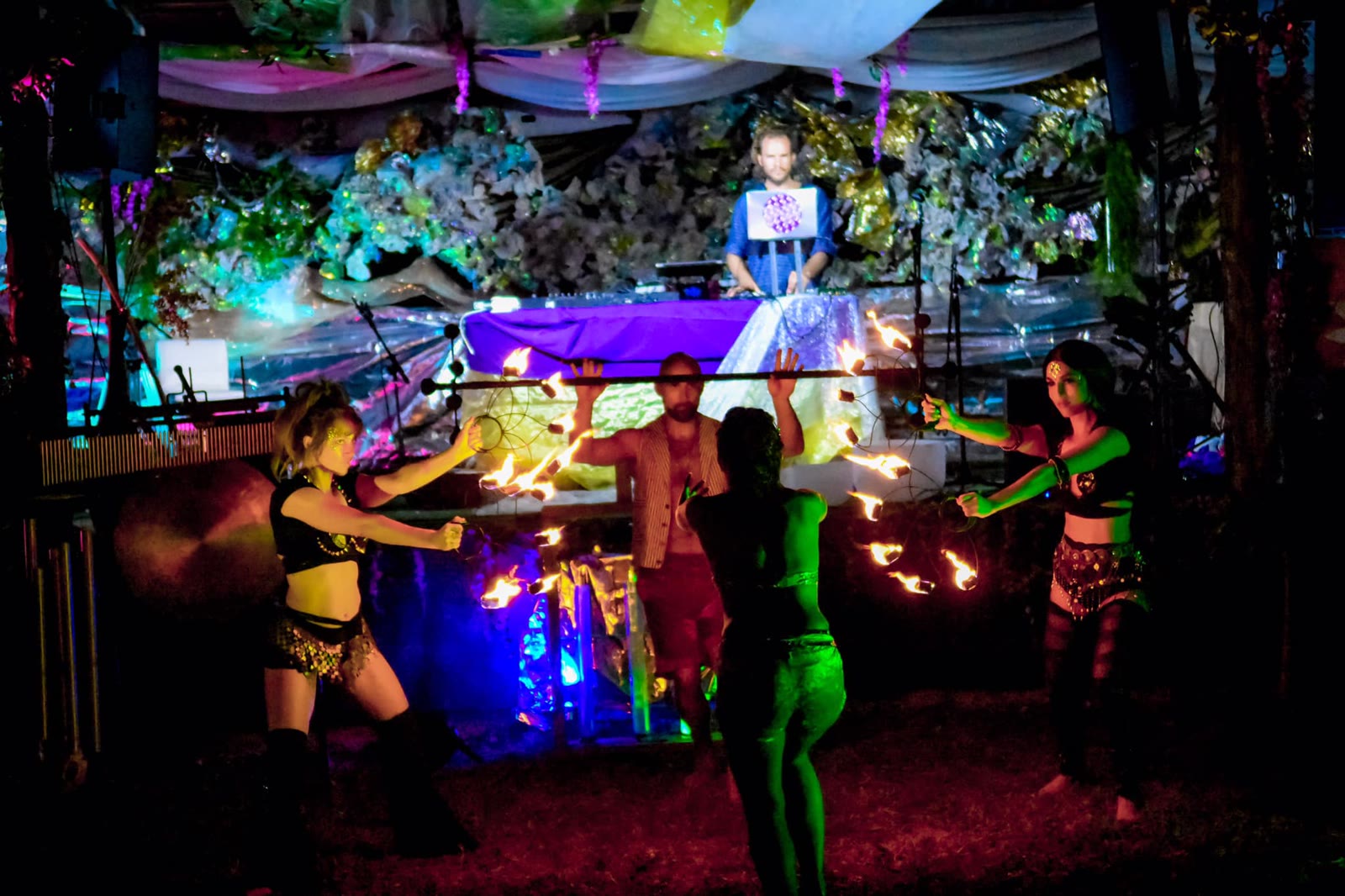 Fire and bass live · October 20, 2026