Fire Performers With a DJ Set: Booking and Staging
What it takes to book fire performers, dancers and aerial with a live bass DJ set, from the rider to the room. Written by an Austin producer who stages it.
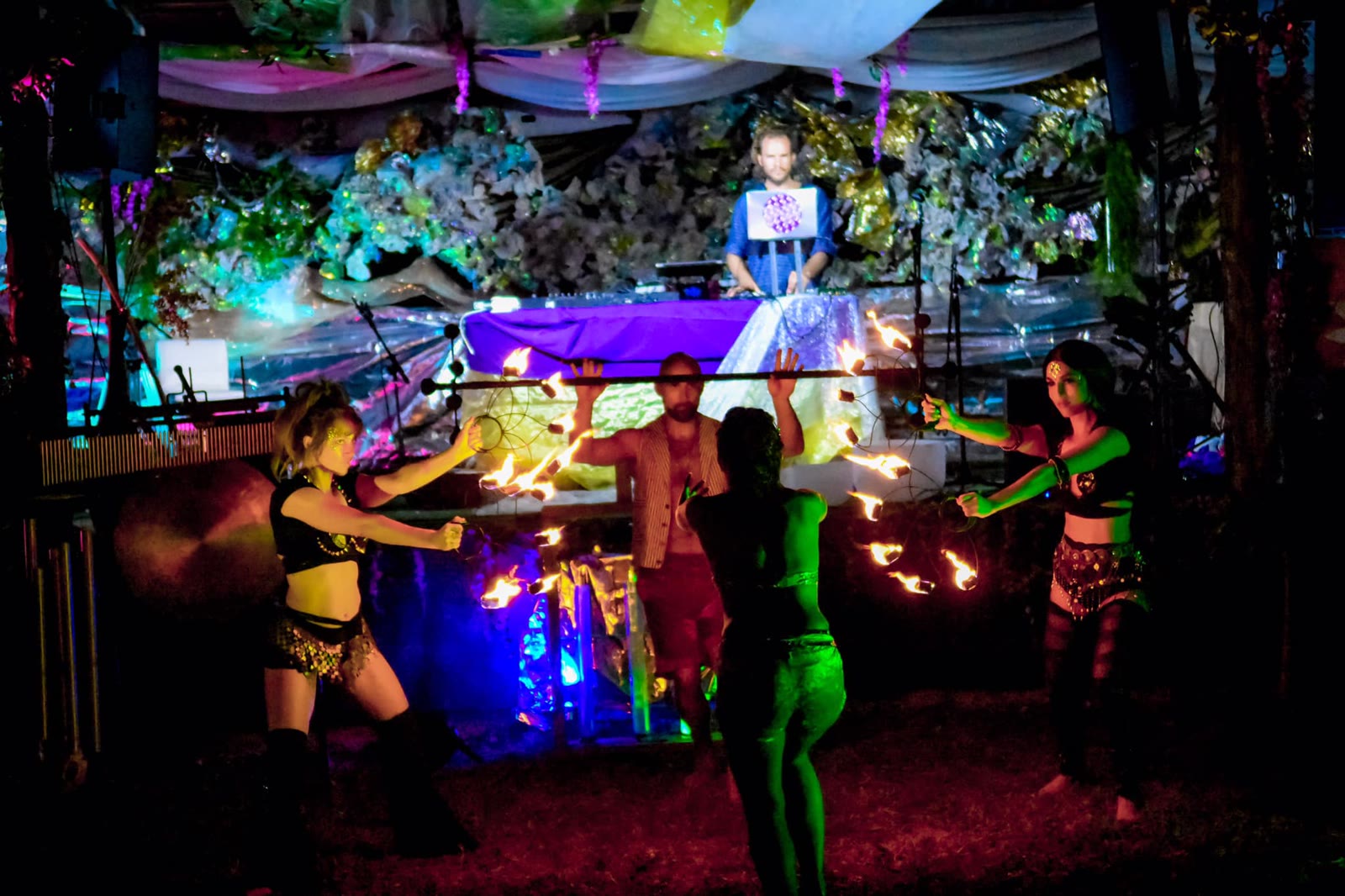
Fire performers with a DJ set is a real thing you can book, and it takes more than adding a fire act to a lineup. You need a DJ who plays to the performers, a venue and organizer who approve fire, a clear plan for who is responsible for what, and a set that matches the room. Done well, the music leads and the fire answers it. Done badly, it is two shows sharing a stage.
I'm Jordan Larsen, and I run The Great Medicine Show, an Austin bass and electronic project. The live show runs from a solo DJ set to a full production with dancers, fire performers and aerial. This is what I've learned about booking it, staging it, and deciding how much of it a room actually needs.
What does a DJ set with fire performers actually include?
It depends on the configuration, and the honest answer starts with asking which one you want. I think of three.
The first is the solo DJ set. Just the music, built to move a floor through an arc rather than hold one level. Most rooms need exactly this.
The second is the set with a few specialty performers. A couple of dancers, or one fire performer, working to the music in a defined slot of the night.
The third is the full production: dancers, fire and flow arts, aerial, spoken word, projection and storytelling, developed with the promoter as an activation rather than dropped on the stage. My bio puts it simply: a solo set when that is what the room needs, and a full production when it is not.
The mistake I see in booking conversations is treating these as one product. A proposal should name the exact performers and disciplines, say whether fire is part of this booking, and say what the rehearsal expectations are. If a proposal says "fire and dancers" and stops there, nobody knows what they are buying.
How do you book fire performers with a DJ?
Start from the room, not the act. Before anything else, find out three things: whether the venue or festival allows open flame at all, who signs that off, and what the surface and ceiling look like. Indoors, outdoors on grass, on a deck and under a tent are four different conversations.
Then work through this in order:
- Decide the configuration. Solo set, set plus a few performers, or full production. Be specific about disciplines.
- Confirm approvals early. Fire usually needs the organizer's agreement and often the local fire authority's. Ask who handles it, and ask before the poster is printed, not after.
- Ask for insurance and safety documentation. Professional fire performers carry coverage and work with a safety person. A venue will often want a certificate. If a performer cannot produce one, that tells you something.
- Write down the technical needs. Stage dimensions, power, backstage space, load-in, changeover time, a fuel storage plan, and where the audience stands relative to the flame.
- Fix the cue points. Which moments in the set are for the performers, and which are for the floor.
For general fire safety context, the National Fire Protection Association is the standards body most venue officials point to: nfpa.org. Your local rules will be stricter or looser than any general advice, so treat the organizer and the authority as the final word.
If you want the set list, the history and the configurations in one place, the press kit has them. To hire the crew itself, start with fire performers for events, or see every way to book the show.
What have I learned from staging it?
The biggest lesson is that the music has to leave space. A bass set that is wall to wall at full intensity gives a fire performer nothing to respond to. The best moments happen when a drop is allowed to land, the room breathes, and then the performer has room to move. That is the same arc I try to write into the music anyway: dubstep, jungle, garage, house and trance between 85 and 155 BPM, built to take a floor somewhere rather than park it.
Rehearsal is the second lesson. In 2024 I built an expanded Great Medicine Show production for Music for the People in Belton, Texas. The cast was more than fourteen performers, with months of rehearsal behind it, and the event sold out. Nothing about that came from improvising on the night. The months of rehearsal were what let the performers trust the cues and the music trust the performers. If you are booking a full production and the budget has no rehearsal in it, the show will look like it.
The third lesson is that specialty acts belong to the occasion. The same elements read differently in different places:
- At Indra's Awarehouse in Austin, I've played with aerial, acrobatic and cirque elements on a New Year's Eve billing, and at the Alchemical Bass Symphony in April 2024, a night built around sound healing, cacao, circus arts and fire, co-billed with Axel Thesleff, Govinda and AKRIZA.
- At a festival-style wedding in Wimberley, Texas, the event planner's own write-up credits fire and belly dance entertainment alongside live music.
- At festivals like Unison, PlayThink and Quantum Awakening, which have all listed The Great Medicine Show, the question is different again. A festival stage is a long walk from the next one, the crowd arrives from other sets, and your set time shapes what the music should do.
I don't bring the same show to each. I bring the same people and the same songs, and I change how much stage there is around them.
How do you match the set to the room?
This is the part that decides whether the night works. A dance floor, a festival stage, a wedding and a ceremony each want something different, and a set that works in one can fall flat in another.
My rule is plain. If I'm playing an ecstatic dance, the set should be one I have actually played at an ecstatic dance. If I'm playing a festival, it should be a festival set. I keep those separate, and when a booker asks for a recording, I send the one that matches their room, not the one I happen to like best. A gentle opening and long builds suit a dance. A festival crowd walking in from another stage often wants energy sooner.
Fire changes the math in a specific way. Fire is most striking when it is dark and the crowd is already invested, so the performers go late in the set and the music builds toward them. It also changes the pace of the room. People stop dancing to watch. A good set lets them watch, then gives them a reason to start moving again.
Practical things to settle with the performers before the night:
- The tempo range of the section they will perform to, so they can choose their material.
- A way to signal that something has gone wrong and the music should change or stop.
- Who decides to cut a fire segment if the wind rises or the crowd moves closer. It should be the safety person or the lead performer, and everyone should know who it is.
What can go wrong?
Most problems are scoping problems, not fire problems. A venue assumes the booking includes fire when it does not. A promoter assumes a full cast when the budget was for a DJ. A performer arrives and the stage is a carpet, a low ceiling or a surface that won't take flame.
The fix is dull and it works: put every element in writing. Name the people, name the disciplines, state whether fire, props or projection are included, and list the audio setup, the mixer and deck requirements, the monitor layout, the soundcheck length and a backup playback plan. I'd rather spend an hour on that than learn it at load-in.
Questions people ask
Can a DJ set and fire performers share a small stage?
Sometimes, but usually the fire needs its own space away from the decks, the crowd and anything flammable. In a small room the answer may be fire outside and everything else inside. Ask the organizer and measure before promising.
Do I have to book the whole production?
No. You can book the set alone and add performers later, or start with a few specialty acts. A larger production takes rehearsal and a bigger budget, so it is best decided early.
What does the music need to be like for fire?
It needs structure. Clear builds, drops that land, and space between them. A set with a considered arc gives performers something to work with.
How far ahead should I ask?
As early as you can, because approvals, insurance and rehearsal all take time. If fire is part of the plan, raise it in the first conversation.
What to do next
If you are planning a night and wondering which configuration fits, read the press kit for what the show has looked like on stage, or go to the links page to hear the music and get in touch. Tell me the room, the date and the crowd, and I'll tell you honestly whether it wants a solo set or something bigger.
 The music · October 27, 2026